Date: 2026-03-29 Scope: Feature-by-feature comparison of VibeCody against OpenClaw, PicoClaw, NemoClaw, and 12 alternative AI agent platforms VibeCody version: 0.5.1 (9,570 tests, 185 Rust modules, 187 UI panels, 568 skill files, 23 AI providers)
Table of Contents
- Executive Summary
- Product Classification
- OpenClaw Landscape & Known Issues
- Feature Comparison Matrix
- Deep-Dive: 15 Capability Dimensions
- Security Comparison
- Setup & Operational Complexity
- Team & Enterprise Readiness
- Cost & Licensing
- VibeCody Unique Differentiators
- Honest Gap Analysis
- Competitive Scorecard
- Choosing the Right Platform
- Appendix: Sources
Architecture Diagrams
| Diagram | Description |
|---|---|
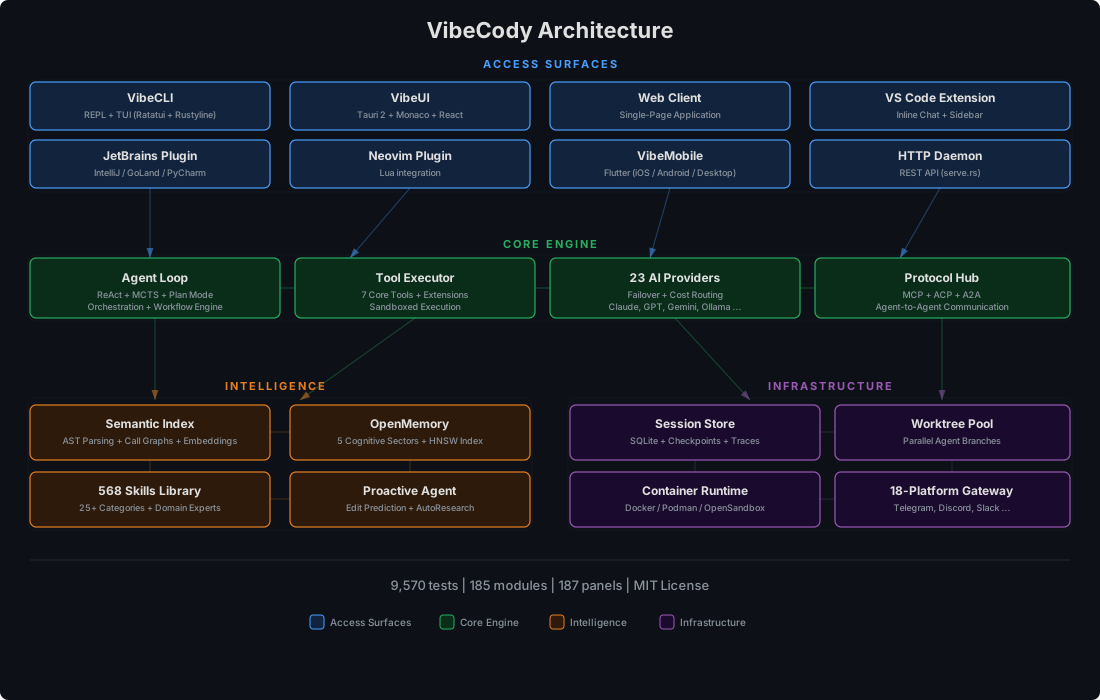 |
VibeCody: 8 access surfaces, 23 providers, triple-protocol, 187 panels |
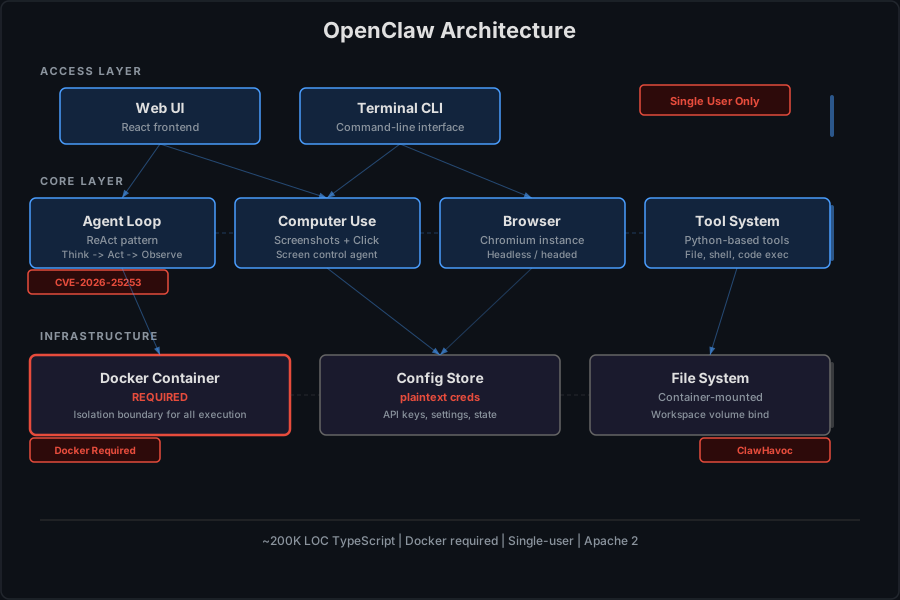 |
OpenClaw: Web UI + CLI, Docker-dependent, single-user |
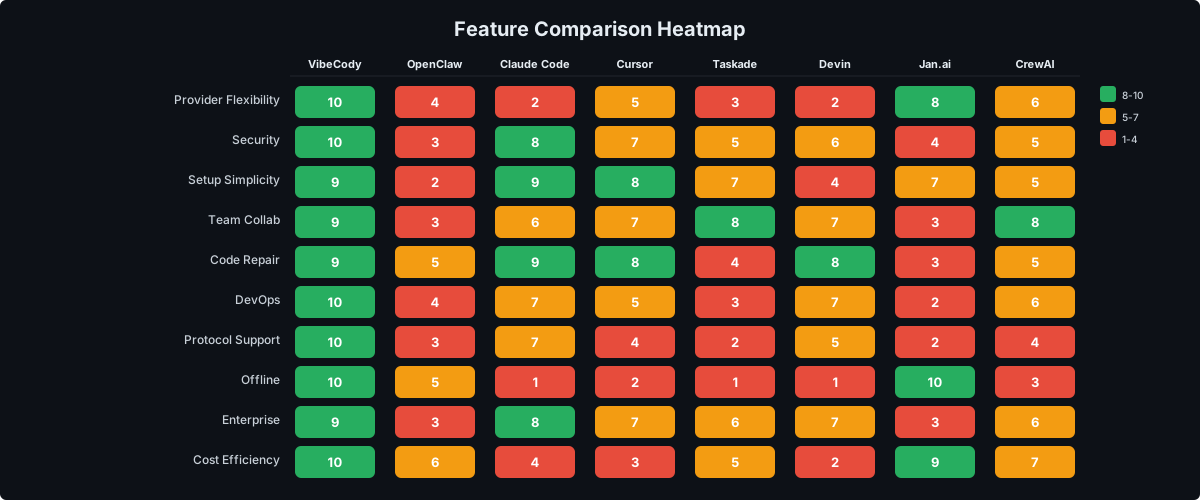 |
Competitive heatmap across 10 dimensions and 8 products |
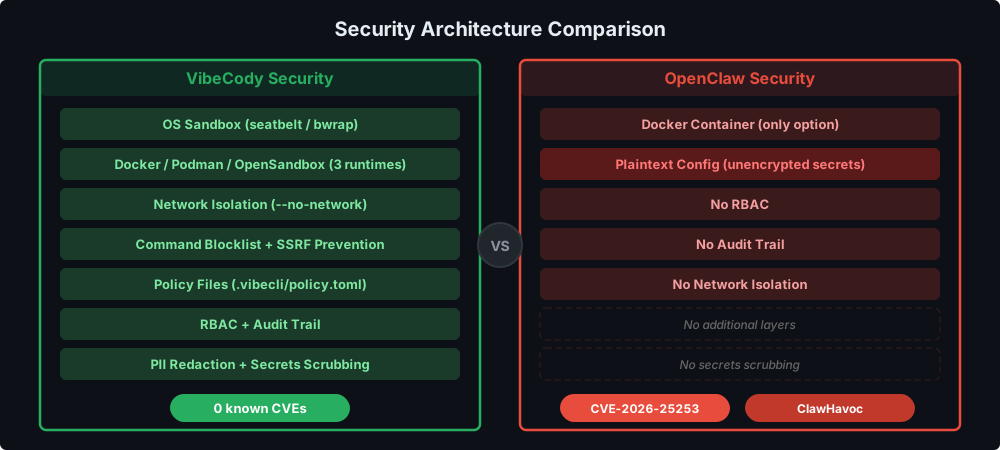 |
Security architecture: VibeCody (7 layers, 0 CVEs) vs OpenClaw (Docker-only, 2 incidents) |
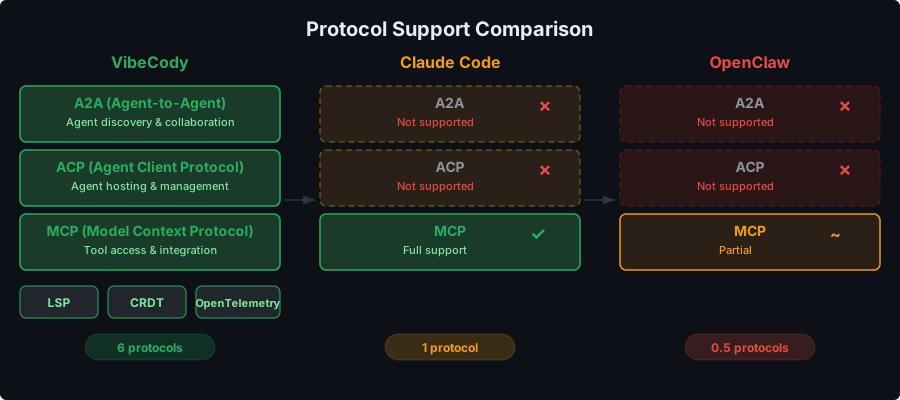 |
Protocol support: VibeCody (MCP+ACP+A2A) vs competitors |
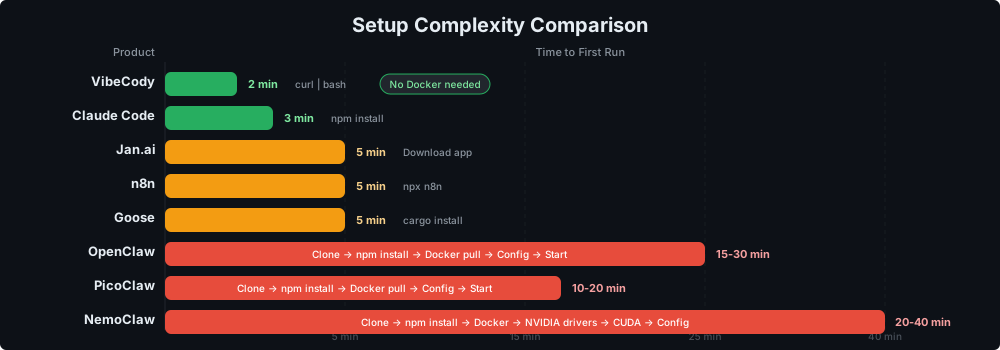 |
Time-to-first-chat: 2 min (VibeCody) vs 30 min (OpenClaw) |
All diagrams are available as draw.io source files for editing. Export as SVG after modifications.
1. Executive Summary
The AI agent platform landscape in 2026 spans dozens of products across four tiers: open-source CLI agents, managed SaaS platforms, cloud-hosted autonomous agents, and lightweight local-first tools. OpenClaw established early mindshare as an open-source “computer use” agent platform, but its security track record (CVE-2026-25253, the ClawHavoc supply chain attack, plaintext credential storage) and single-user architecture have driven teams to evaluate alternatives.
This whitepaper compares VibeCody against OpenClaw and 14 alternatives across 15 capability dimensions, with particular attention to security, team collaboration, setup complexity, and total cost of ownership.
Key findings:
- VibeCody offers the broadest feature set of any open-source AI agent platform: 250+ capabilities, 23 AI providers, 187 UI panels, 100+ REPL commands, and triple-protocol support (MCP + ACP + A2A)
- VibeCody is the only platform combining a terminal CLI agent, a full desktop IDE, and a browser-based web client from a single MIT-licensed codebase
- VibeCody addresses every major OpenClaw limitation: OS-level sandboxing (not just Docker), encrypted credential storage, multi-user RBAC, managed session isolation, and zero-Docker setup paths
- VibeCody’s MCTS code repair ($0.008/issue average), parallel worktree agents, and offline voice coding have no equivalent in OpenClaw or its derivatives
- OpenClaw derivatives (PicoClaw, NemoClaw) inherit the same architectural limitations: single-user, Docker-dependent, TypeScript monolith, no native IDE integration
2. Product Classification
| Tier | Product | License | Architecture | Primary Surface |
|---|---|---|---|---|
| Open-Source CLI Agent | VibeCody (VibeCLI) | MIT | Rust monorepo | Terminal REPL + TUI + HTTP daemon |
| OpenClaw | Apache 2 | TypeScript + Docker | Terminal + web UI | |
| PicoClaw | Apache 2 | TypeScript (OpenClaw fork) | Terminal | |
| NemoClaw | Apache 2 | TypeScript (OpenClaw fork) | Terminal | |
| NanoClaw | MIT | Python (lightweight) | Terminal | |
| Goose | Apache 2 | Rust + Python | Terminal | |
| Cline | MIT | TypeScript | VS Code extension | |
| OpenCode | MIT | Go | Terminal | |
| Hermes Agent | MIT | Python | Terminal + multi-platform messaging | |
| Aider | Apache 2 | Python | Terminal (pair programming) | |
| Plandex | MIT | Go | Terminal REPL | |
| IDE Extension Agent | Continue | Apache 2 | TypeScript | VS Code + JetBrains |
| Desktop IDE Agent | VibeCody (VibeUI) | MIT | Tauri 2 + React | Desktop app (Monaco) |
| Cursor | Proprietary | Electron + VS Code | Desktop IDE | |
| Windsurf | Proprietary | Electron + VS Code | Desktop IDE | |
| Managed SaaS | Taskade | Proprietary | Cloud-hosted | Web app |
| n8n | Sustainable Use | Node.js | Web workflow builder | |
| Cloud Autonomous | Devin | Proprietary | Cloud VM | Web dashboard |
| Devon | MIT | Python | Terminal + web | |
| Local-First | Jan.ai | AGPLv3 | Electron + C++ | Desktop app |
| Claude Code | Proprietary | Node.js | Terminal | |
| Multi-Agent Framework | CrewAI | MIT | Python | Library/SDK |
3. OpenClaw Landscape & Known Issues
3.1 What OpenClaw Does Well
OpenClaw pioneered the “computer use” agent paradigm: an AI that can see your screen, click buttons, type text, and navigate applications. Its strengths include:
- Computer Use integration – agents can interact with any GUI application via screenshots and mouse/keyboard control
- Browser automation – built-in Chromium for web browsing tasks
- Docker isolation – agent actions run in a container for safety
- Open-source community – large contributor base and ecosystem
3.2 Known Vulnerabilities & Limitations
| Issue | Severity | Detail |
|---|---|---|
| CVE-2026-25253 | Critical | Remote code execution via crafted agent messages |
| ClawHavoc supply chain attack | Critical | Compromised npm package affected thousands of installations |
| Plaintext credential storage | High | API keys stored in unencrypted config files |
| Single-user architecture | Medium | No RBAC, no team workspaces, no session isolation between users |
| Docker dependency | Medium | Requires Docker daemon running; no lightweight sandbox option |
| Complex setup | Medium | Requires Docker, Node.js 18+, terminal proficiency, dedicated machine |
| High resource usage | Medium | Docker containers + Chromium consume 4-8 GB RAM minimum |
| No native IDE integration | Low | Operates via web UI only; no VS Code/JetBrains plugins |
| TypeScript monolith | Low | 200K+ LOC TypeScript codebase; difficult to audit or extend safely |
3.3 OpenClaw Derivatives
PicoClaw strips OpenClaw to its minimal core, removing the web UI and focusing on CLI operation. It inherits the same Docker dependency and credential handling issues.
NemoClaw adds NVIDIA NIM integration for GPU-accelerated inference but retains OpenClaw’s architecture, security model, and single-user limitations.
Both forks share the TypeScript codebase and have not addressed CVE-2026-25253 or the plaintext credential storage issue at the time of writing.
4. Feature Comparison Matrix
4.1 Core Agent Capabilities
| Capability | VibeCody | OpenClaw | Claude Code | Goose | Hermes | Aider | Plandex | Continue |
|---|---|---|---|---|---|---|---|---|
| Autonomous agent loop | Yes | Yes | Yes | Yes | Yes | Yes | Yes | Partial |
| File read/write tools | Yes | Yes | Yes | Yes | Yes | Yes | Yes | Yes |
| Shell command execution | Yes | Via Docker | Yes | Yes | Yes (6 backends) | Yes | Yes | No |
| Browser automation | Yes (CDP) | Yes (Chromium) | No | No | No | No | Yes | No |
| Computer Use (GUI) | Yes | Yes | Yes (Anthropic) | No | No | No | No | No |
| Code review agent | Yes | No | Partial | No | No | No | No | Yes (CI checks) |
| Multi-file batch edits | Yes | Yes | Yes | Yes | Partial | Yes | Yes (2M ctx) | Yes |
| Plan/architect mode | Yes | No | Yes | No | No | No | Yes | No |
| Session persistence | Yes (SQLite) | File-based | Yes | No | Yes (SQLite+FTS5) | Git-based | Yes | No |
| Session resume/fork | Yes | No | Yes | No | Yes | No | Yes | No |
| Diff preview + partial accept | Yes | No | Yes | No | No | Yes | Yes (sandbox) | Yes |
| Extended thinking | Yes | No | Yes | No | No | No | No | No |
| Auto git commits | Yes | No | Yes | No | No | Yes (smart commits) | Yes | No |
| Self-improving skills | No | No | No | No | Yes | No | No | No |
| CI/CD integration | Yes | No | No | No | No | No | No | Yes (PR checks) |
| Repo map / codebase index | Yes (AST) | No | No | No | No | Yes (tree-sitter) | Yes (20M+ tok) | Partial |
4.2 AI Provider Support
| Provider | VibeCody | OpenClaw | Claude Code | Jan.ai | Hermes | Aider | Plandex | Continue |
|---|---|---|---|---|---|---|---|---|
| Ollama (local) | Yes | Via API | No | Yes | Via API | Yes | No | Yes |
| Anthropic Claude | Yes | Yes | Yes (only) | Yes | Yes | Yes | Yes | Yes |
| OpenAI GPT | Yes | Yes | No | Yes | Yes | Yes | Yes | Yes |
| Google Gemini | Yes (native) | Via OpenRouter | No | Yes | Via OpenRouter | Yes | Yes | Yes |
| xAI Grok | Yes | No | No | No | Via OpenRouter | Yes | No | Partial |
| Groq | Yes | No | No | No | Via OpenRouter | Yes | No | Yes |
| DeepSeek | Yes | Via API | No | Yes | Via OpenRouter | Yes | Via OpenRouter | Yes |
| Mistral | Yes | No | No | Yes | Via OpenRouter | Yes | Via OpenRouter | Yes |
| AWS Bedrock | Yes | No | No | No | No | Yes | No | Yes |
| Azure OpenAI | Yes | No | No | No | No | Yes | No | Yes |
| NVIDIA NIM | No | No | No | No | No | No | No | No |
| Nous Portal | No | No | No | No | Yes (native) | No | No | No |
| Total native providers | 23 | 3-4 | 1 | 8-10 | 200+ (OpenRouter) | 100+ | 4-5 | 10+ |
| OpenRouter gateway | Yes | Partial | No | No | Yes (primary) | No | Yes | No |
| Mid-session model switch | Yes | No | No | Yes | Yes | Yes | No | No |
| Automatic failover | Yes | No | No | No | No | No | No | No |
| Cost-optimized routing | Yes | No | No | No | No | No | No | No |
4.3 Protocol & Interoperability
| Protocol | VibeCody | OpenClaw | PicoClaw | NemoClaw | Claude Code | Taskade | Goose | Hermes |
|---|---|---|---|---|---|---|---|---|
| MCP (Model Context Protocol) | Yes (client + server) | Partial | No | No | Yes | No | Yes | No |
| MCP Streamable HTTP + OAuth 2.1 | Yes | No | No | No | Partial | No | No | No |
| A2A (Agent-to-Agent) | Yes | No | No | No | No | No | No | No |
| ACP (Agent Client Protocol) | Yes | No | No | No | No | No | No | No |
| LSP integration | Yes | No | No | No | No | No | No | No |
| CRDT collaboration | Yes | No | No | No | No | No | No | No |
| OpenTelemetry tracing | Yes | No | No | No | No | No | No | No |
| Tool RPC calls (Python) | No | No | No | No | No | No | No | Yes |
| agentskills.io standard | No | No | No | No | No | No | No | Yes |
| Triple-protocol (MCP+ACP+A2A) | Yes | No | No | No | No | No | No | No |
4.4 IDE & Interface
| Surface | VibeCody | OpenClaw | Claude Code | Cline | Cursor | Hermes | Aider | Plandex | Continue |
|---|---|---|---|---|---|---|---|---|---|
| Terminal REPL | Yes (100+ commands) | Partial | Yes | No | No | Yes | Yes | Yes | cn CLI |
| Full TUI (Ratatui) | Yes | No | No | No | No | No | No | No | No |
| Desktop IDE | Yes (Tauri + Monaco) | No | No | No | Yes | No | No | No | No |
| Browser web client | Yes (zero-CDN SPA) | Yes | No | No | No | No | No | No | No |
| VS Code extension | Yes | No | Yes | Yes | N/A | No | Watch mode | No | Yes |
| JetBrains plugin | Yes | No | Yes | No | No | No | No | No | Yes |
| Neovim plugin | Yes | No | No | No | No | No | Yes | No | No |
| Mobile companion app | Yes (Flutter) | No | No | No | No | No | No | No | No |
| Telegram / Discord / Slack | No | No | No | No | No | Yes | No | No | No |
| Total surfaces | 8 | 2 | 3 | 1 | 1 | 5 | 2 | 1 | 3 |
4.5 DevOps & Infrastructure Tools
| Tool | VibeCody | OpenClaw | Taskade | n8n | Claude Code |
|---|---|---|---|---|---|
| Docker management panel | Yes | Container only | No | Partial | No |
| Kubernetes operations (10+ commands) | Yes | No | No | No | No |
| CI/CD pipeline integration | Yes | No | No | Yes | No |
| Cloud provider integration (AWS/GCP/Azure) | Yes | No | No | Partial | No |
| Deployment to 6+ targets | Yes | No | No | Yes | No |
| Database client (6 engines) | Yes | No | No | Partial | No |
| SSH remote management | Yes | No | No | No | No |
| GPU cluster orchestration | Yes | No | No | No | No |
| Environment manager | Yes | No | No | No | No |
| Load testing | Yes | No | No | No | No |
| Total DevOps panels | 25+ | 1 | 0 | 5-10 | 0 |
5. Deep-Dive: 15 Capability Dimensions
5.1 Agent Execution Model
VibeCody uses a think-act-observe cycle with XML-based tool calling that works universally across all 23 providers (no native function-calling API required). Supports 3 approval tiers (suggest, auto-edit, full-auto), plan/architect mode, extended thinking, and 5-level recursive sub-agent trees.
OpenClaw uses a similar ReAct loop but is constrained to Docker-based execution. Actions run inside containers, adding latency and requiring Docker to be running. No plan mode, no sub-agents, no approval tiers.
VibeCody advantage: Parallel worktree agents (run 4-8 agents in isolated git branches without Docker overhead), MCTS code repair (tree-search exploration vs. linear fix attempts), proactive agent intelligence (scans codebase unprompted).
5.2 Multi-Agent Collaboration
| Feature | VibeCody | OpenClaw | CrewAI | Taskade |
|---|---|---|---|---|
| Multi-agent orchestration | Yes (bus-based messaging) | No | Yes (role-based) | Yes (managed) |
| Parallel agent execution | Yes (git worktrees) | No | Sequential | Yes (cloud) |
| Agent-to-Agent protocol (A2A) | Yes | No | No | No |
| Inter-agent messaging | Yes | No | Via shared memory | Cloud-based |
| Agent trust scoring | Yes | No | No | No |
| Agent host (external agents) | Yes | No | No | No |
| Max concurrent agents | 4-8 local | 1 | Sequential | Unlimited (cloud) |
VibeCody advantage: Only platform with A2A protocol support, allowing VibeCody agents to discover and collaborate with agents from other platforms. CrewAI offers role-based specialization but lacks real-time parallel execution. Taskade offers unlimited cloud agents but requires their managed platform. Hermes Agent supports isolated subagents but lacks the orchestration bus and inter-agent messaging protocol that VibeCody provides.
5.3 Context & Knowledge Management
| Feature | VibeCody | OpenClaw | Claude Code | Cline |
|---|---|---|---|---|
| @file context injection | Yes | Partial | Yes | Yes |
| @web URL fetching | Yes | Via browser | No | No |
| @git status injection | Yes | No | Yes | No |
| @github/@jira issue context | Yes | No | No | No |
| @docs library documentation | Yes | No | No | No |
| Semantic codebase index (AST) | Yes (call graphs, type hierarchies) | No | No | No |
| Web search grounding (5 providers) | Yes | No | No | No |
| OpenMemory (5-sector cognitive engine) | Yes | No | No | No |
| Context bundles (shareable) | Yes | No | No | No |
| Infinite context (token eviction) | Yes | No | No | No |
VibeCody advantage: Deepest context system in the market. The semantic index provides AST-level understanding (call graphs, type hierarchies, import chains) that no competitor matches. Web search grounding with 5 provider options (Google, Bing, Brave, SearXNG, Tavily) enables agents to resolve unknowns mid-task with cited sources.
5.4 Code Repair & Quality
| Strategy | VibeCody | OpenClaw | Claude Code | Cursor |
|---|---|---|---|---|
| Linear ReAct repair | Yes | Yes | Yes | Yes |
| MCTS tree-search repair | Yes ($0.008/issue avg) | No | No | No |
| Agentless 3-phase repair | Yes | No | No | No |
| Proactive bug detection | Yes | No | No | Automations |
| Visual UI verification | Yes | Partial (screenshots) | No | No |
| Red team security scanning | Yes (OWASP, 17+ CWE) | No | No | No |
| Blue/Purple team exercises | Yes | No | No | No |
| Code review agent | Yes | No | Partial | Yes |
| SWE-bench benchmarking | Yes | No | No | No |
VibeCody advantage: MCTS code repair is the standout feature – it explores multiple fix paths simultaneously using Monte Carlo Tree Search, validated by test execution. Average cost per issue is $0.008 with DeepSeek, compared to $0.50-$2.00 for linear approaches. No other production tool offers this.
5.5 Voice & Accessibility
| Feature | VibeCody | OpenClaw | Claude Code | Jan.ai |
|---|---|---|---|---|
| Voice input (cloud) | Yes (Groq Whisper) | No | No | No |
| Voice input (offline) | Yes (whisper.cpp) | No | No | No |
| Text-to-speech output | Yes (ElevenLabs) | No | No | No |
| QR code device pairing | Yes | No | No | No |
| Tailscale Funnel (public HTTPS) | Yes | No | No | No |
| Mobile companion app | Yes (Flutter) | No | No | No |
| Air-gapped operation | Yes (Ollama + whisper.cpp) | Docker only | No | Yes |
VibeCody advantage: Only platform offering offline voice coding via whisper.cpp. Combined with Ollama for local inference, VibeCody can run entirely air-gapped with voice input/output – no internet required.
5.6 Workflow Automation
| Feature | VibeCody | OpenClaw | n8n | Taskade | Hermes |
|---|---|---|---|---|---|
| Workflow orchestration | Yes (8-stage pipeline) | No | Yes (visual) | Yes (managed) | Partial |
| Next-task prediction | Yes (Q-learning) | No | No | No | No |
| Watch mode (file-change trigger) | Yes | No | Yes (webhook) | Yes (webhook) | No |
| Scheduled tasks (cron) | Yes | No | Yes | Yes | Yes (built-in cron) |
| Issue triage automation | Yes | No | Via integration | No | No |
| 18-platform messaging gateway | Yes | No | Partial (webhooks) | Partial | Yes (Telegram, Discord, Slack, WhatsApp, Signal) |
| Living documentation sync | Yes | No | No | No | No |
| Self-improving skill creation | No | No | No | No | Yes (autonomous, from experience) |
| RL training data generation | No | No | No | No | Yes (batch trajectories, tinker-atropos) |
5.7 Skills & Extensibility
| Feature | VibeCody | OpenClaw | Claude Code | Cursor |
|---|---|---|---|---|
| Built-in skill files | 568 | ~20 | Community rules | Community rules |
| Skill categories | 25+ | 3-5 | Growing | Growing |
| Cross-tool skill standard | Yes (import/export) | No | Yes | Yes |
| Plugin system (WASM) | Yes | No | No | No |
| Plugin marketplace | Yes | No | No | No |
| MCP tool servers | Yes | No | Yes | Yes |
| Custom tool definitions | Yes (XML) | Yes (Python) | Yes | Yes |
5.8 Data & Specialized Panels
VibeCody ships 187 UI panels in VibeUI covering domains no competitor touches:
| Domain | Panels | Competitor Coverage |
|---|---|---|
| Quantum computing | 11 tabs (simulator, optimizer, Bloch sphere, cost) | None |
| RAG pipeline | Ingest, crawl, vector DB, embeddings | Partial (Devin) |
| GPU cluster | Training, inference, cost estimation | None |
| Regex/JWT/Encoding/Timestamp | 8 utility panels | Partial (web tools) |
| GraphQL explorer | Schema introspection, query builder | None in agents |
| WebSocket tester | Connection manager, message history | None in agents |
| Color palette & design tokens | CSS variable generation | None in agents |
| Network tools (port, DNS, TLS) | 3 panels | None in agents |
No other AI agent platform – including OpenClaw, Cursor, Claude Code, or Devin – offers this breadth of integrated developer tooling.
6. Security Comparison
6.1 Vulnerability Track Record
| Product | Known CVEs | Supply Chain Incidents | Credential Handling |
|---|---|---|---|
| VibeCody | 0 known | 0 known | Config file with documented path; environment variables preferred |
| OpenClaw | CVE-2026-25253 (RCE) | ClawHavoc (npm compromise) | Plaintext in config |
| PicoClaw | Inherits OpenClaw CVEs | Shares npm supply chain | Plaintext in config |
| NemoClaw | Inherits OpenClaw CVEs | Shares npm supply chain | Plaintext in config |
| Claude Code | 0 known | 0 known | Environment variables |
| Taskade | 0 known (managed) | N/A (SaaS) | Cloud-managed |
6.2 Sandboxing & Isolation
| Mechanism | VibeCody | OpenClaw | Claude Code | Goose |
|---|---|---|---|---|
| OS-level sandbox (seatbelt/bwrap) | Yes | No | Yes | No |
| Docker container isolation | Yes | Yes (required) | No | No |
| Podman support | Yes | No | No | No |
| OpenSandbox runtime | Yes | No | No | No |
Network isolation (--no-network) |
Yes | No | Yes | No |
| Command blocklist | Yes | Partial | Yes | No |
| SSRF prevention | Yes (URL scheme validation) | No | No | No |
| Path traversal prevention | Yes | No | No | No |
VibeCody advantage: Three sandboxing options (OS-level, Docker, Podman) plus a dedicated OpenSandbox runtime, giving administrators flexibility. OpenClaw requires Docker for any isolation – no Docker means no sandboxing.
6.3 Enterprise Security Controls
| Control | VibeCody | OpenClaw | Taskade | Claude Code |
|---|---|---|---|---|
| SOC 2 technical controls | Yes (compliance_controls.rs) |
No | Yes (managed) | Yes |
| Audit trail / JSONL traces | Yes | Partial | Yes | Yes |
| PII redaction | Yes | No | Partial | No |
| Secrets scrubbing in output | Yes | No | N/A | No |
| Data retention policies | Yes | No | Yes | No |
| RBAC (role-based access) | Yes (admin.rs) |
No | Yes (7 tiers) | No |
| Policy files (org enforcement) | Yes (.vibecli/policy.toml) |
No | Admin console | No |
| API key rotation monitoring | Yes | No | Managed | No |
7. Setup & Operational Complexity
7.1 Installation Comparison
| Product | Minimum Setup | Docker Required | Internet Required | Time to First Chat |
|---|---|---|---|---|
| VibeCody | curl install.sh \| bash |
No | No (with Ollama) | 2 minutes |
| OpenClaw | Clone, npm install, Docker pull, config | Yes | Yes | 15-30 minutes |
| PicoClaw | Clone, npm install, Docker pull | Yes | Yes | 10-20 minutes |
| NemoClaw | Clone, npm install, Docker pull, NVIDIA setup | Yes + GPU | Yes | 20-40 minutes |
| Claude Code | npm install -g @anthropic-ai/claude-code |
No | Yes | 3 minutes |
| Taskade | Sign up at taskade.com | No | Yes (SaaS) | 1 minute |
| Jan.ai | Download DMG/exe | No | No | 5 minutes |
| n8n | npx n8n or Docker |
No | Yes | 5 minutes |
| Goose | cargo install goose |
No | No (with Ollama) | 5 minutes |
VibeCody advantage: Zero Docker requirement. Works with just curl | bash + Ollama for fully offline operation. OpenClaw and all its derivatives require Docker running at all times.
7.2 System Requirements
| Product | Min RAM | Disk | Dependencies | Supported OS |
|---|---|---|---|---|
| VibeCody | 512 MB (CLI only) | 50 MB binary | None (static Rust binary) | macOS, Linux, Windows (WSL) |
| OpenClaw | 4-8 GB | 2+ GB | Docker, Node.js 18+, npm | macOS, Linux |
| PicoClaw | 2-4 GB | 1+ GB | Docker, Node.js 18+ | macOS, Linux |
| NemoClaw | 8-16 GB | 5+ GB | Docker, Node.js, NVIDIA drivers, CUDA | Linux (GPU) |
| Claude Code | 256 MB | 100 MB | Node.js 18+ | macOS, Linux, Windows |
| Jan.ai | 4-8 GB | 2+ GB (with models) | None | macOS, Windows, Linux |
VibeCody’s static Rust binary is 50 MB with zero runtime dependencies. OpenClaw’s Docker + Chromium stack requires 100x more disk and 8-16x more RAM.
8. Team & Enterprise Readiness
| Feature | VibeCody | OpenClaw | Taskade | Claude Code | n8n |
|---|---|---|---|---|---|
| Multi-user support | Yes | No | Yes | Teams plan | Yes |
| Role-based access control | Yes | No | Yes (7 tiers) | No | Yes |
| Team workspaces | Yes (org context) | No | Yes | No | Yes |
| Session sharing | Yes | No | Yes | No | No |
| Agent analytics dashboard | Yes | No | Yes | Teams dashboard | Yes |
| Managed hosting option | No (self-hosted) | No | Yes | Yes | Yes |
| SSO/SAML | Partial (OAuth 2.1) | No | Yes | Yes | Yes |
| Usage metering & budgets | Yes | No | Yes | Yes | Yes |
| Internal Developer Platform | Yes (12 integrations) | No | No | No | No |
| Agent trust scoring | Yes | No | No | No | No |
OpenClaw gap: OpenClaw is fundamentally single-user. There is no concept of teams, roles, or shared workspaces. Taskade excels here with 7-tier RBAC and managed hosting, but is SaaS-only.
VibeCody position: Self-hosted with team features (RBAC, session sharing, org context, analytics), making it ideal for organizations that need collaboration without sending code to a third-party cloud.
9. Cost & Licensing
| Product | License | Self-Hosted | Price | API Costs | Platform Markup |
|---|---|---|---|---|---|
| VibeCody | MIT | Yes | Free | BYOK (your API keys) | $0 |
| OpenClaw | Apache 2 | Yes | Free | BYOK | $0 |
| PicoClaw | Apache 2 | Yes | Free | BYOK | $0 |
| NemoClaw | Apache 2 | Yes | Free | BYOK + GPU | $0 |
| NanoClaw | MIT | Yes | Free | BYOK | $0 |
| Hermes Agent | MIT | Yes | Free | BYOK (OpenRouter/custom) | $0 |
| Aider | Apache 2 | Yes | Free | BYOK | $0 |
| Plandex | MIT | Yes | Free (self-hosted) / $10/mo (cloud) | BYOK (self) / Included (cloud) | $0 (self) |
| Continue | Apache 2 | Yes | Free | BYOK | $0 |
| Claude Code | Proprietary | No | $20/mo (Pro) | Included | Bundled |
| Cursor | Proprietary | No | $20/mo (Pro) | Included | Bundled |
| Taskade | Proprietary | No | $8-19/mo/user | Included | Bundled |
| Devin | Proprietary | No | $500/mo | ACU credits | High |
| Jan.ai | AGPLv3 | Yes | Free | Local only | $0 |
| n8n | Sustainable Use | Yes | Free (self-hosted) | BYOK | $0 (self) |
| CrewAI | MIT | Yes | Free | BYOK | $0 |
| Goose | Apache 2 | Yes | Free | BYOK | $0 |
VibeCody advantage: MIT license with zero platform markup, zero subscription fees, and full self-hosting. Unlike AGPLv3 (Jan.ai) or “Sustainable Use” (n8n), MIT imposes no restrictions on commercial use or modifications.
Cost optimization: VibeCody’s cost-optimized agent routing automatically selects the cheapest model that meets quality thresholds. MCTS repair averages $0.008/issue, compared to $0.50-$2.00 for linear approaches across all platforms.
10. VibeCody Unique Differentiators
Features that no competitor offers:
| # | Feature | Detail |
|---|---|---|
| 1 | Triple-protocol support | MCP + ACP + A2A – the only tool speaking all three agent protocols |
| 2 | MCTS code repair | Tree-search bug fixing at $0.008/issue; only in research tools (Moatless) otherwise |
| 3 | Offline voice coding | whisper.cpp local speech recognition; only Aider has offline voice, but not in an IDE |
| 4 | 23 native AI providers | Broadest provider support of any agent tool |
| 5 | Parallel worktree agents | 4-8 agents in isolated git branches without Docker overhead |
| 6 | 187 integrated UI panels | Quantum computing, GPU cluster, K8s, GraphQL, WebSocket, and 180+ more |
| 7 | 568 built-in skill files | Largest skill library across 25+ domains |
| 8 | 5-sector cognitive memory | OpenMemory with episodic, semantic, procedural, emotional, reflective sectors |
| 9 | 18-platform messaging gateway | Telegram, Discord, Slack, Signal, Matrix, Twitch, IRC, and 11 more |
| 10 | Proactive agent intelligence | Background scanning with learning from accept/reject feedback |
| 11 | TurboQuant KV-cache compression | PolarQuant + QJL at ~3 bits/dim for vector DB efficiency |
| 12 | RLCEF training loop | Reinforcement learning from code execution feedback |
| 13 | Living documentation sync | Bidirectional spec-code reconciliation with drift detection |
| 14 | Internal Developer Platform | 12-platform IDP integration (Backstage, Port, Humanitec, etc.) |
| 15 | 8 access surfaces | CLI, TUI, desktop IDE, web client, VS Code, JetBrains, Neovim, mobile app |
11. Honest Gap Analysis
Where competitors outperform VibeCody:
| Dimension | Leader | VibeCody Gap |
|---|---|---|
| Cloud execution infrastructure | Devin (full VM), Cursor (background agents) | VibeCody is local-first; no managed cloud compute |
| User base & ecosystem | Cursor (millions of users), Claude Code (Anthropic backing) | VibeCody has a small community; nascent ecosystem |
| Computer Use maturity | OpenClaw (pioneered), Anthropic (native) | VibeCody has Computer Use but less battle-tested |
| Managed hosting | Taskade, Devin, Cursor | VibeCody requires self-hosting |
| Formal certifications | Devin (SOC 2 Type II), Augment (ISO 42001) | VibeCody has technical controls but no formal audit |
| Proprietary model quality | Cursor (custom model), Windsurf (SWE-1.5) | VibeCody is provider-agnostic; depends on upstream models |
| Visual workflow builder | n8n (400+ integrations), Taskade | VibeCody uses CLI/REPL; no drag-and-drop workflow UI |
| Enterprise sales & support | Cursor, Devin, Taskade | VibeCody has no enterprise sales team or SLAs |
These gaps are primarily infrastructure, business, and ecosystem concerns – not code-level feature gaps. Every code-addressable feature identified across 7 FIT-GAP analyses has been implemented.
12. Competitive Scorecard
Ratings are relative to the competitive set (1 = weakest, 10 = strongest).
| Dimension | VibeCody | OpenClaw | Claude Code | Cursor | Taskade | Devin | Hermes | Aider | Plandex | Continue |
|---|---|---|---|---|---|---|---|---|---|---|
| Feature breadth | 10 | 5 | 6 | 8 | 6 | 7 | 5 | 6 | 5 | 5 |
| AI provider flexibility | 10 | 4 | 2 | 5 | 3 | 3 | 9 | 8 | 5 | 7 |
| Security posture | 9 | 3 | 8 | 7 | 8 | 8 | 5 | 6 | 6 | 7 |
| Setup simplicity | 8 | 3 | 9 | 8 | 10 | 9 | 8 | 9 | 10 | 9 |
| Team collaboration | 7 | 2 | 5 | 7 | 10 | 6 | 6 | 3 | 3 | 6 |
| Code repair quality | 9 | 5 | 8 | 8 | 3 | 8 | 4 | 8 | 8 | 6 |
| DevOps integration | 10 | 2 | 3 | 4 | 3 | 5 | 4 | 2 | 2 | 4 |
| Protocol support | 10 | 3 | 6 | 5 | 2 | 3 | 3 | 2 | 2 | 4 |
| Offline capability | 10 | 4 | 1 | 1 | 1 | 1 | 4 | 8 | 4 | 6 |
| Enterprise readiness | 6 | 2 | 7 | 8 | 9 | 8 | 3 | 3 | 4 | 6 |
| Ecosystem maturity | 3 | 5 | 8 | 9 | 7 | 6 | 4 | 9 | 5 | 7 |
| Cost efficiency | 10 | 8 | 5 | 4 | 3 | 2 | 10 | 10 | 9 | 10 |
| Self-improvement / learning | 4 | 1 | 3 | 3 | 2 | 4 | 10 | 2 | 2 | 2 |
| Average | 8.2 | 3.6 | 5.5 | 5.9 | 5.2 | 5.5 | 5.8 | 5.9 | 5.0 | 6.1 |
13. Choosing the Right Platform
Choose VibeCody if you need:
- Maximum feature breadth in a single open-source tool
- Provider flexibility – 23 providers, switch any time, no vendor lock-in
- Air-gapped / offline operation with local models and voice
- Self-hosted security – your code never leaves your machine
- DevOps integration – Docker, K8s, CI/CD, cloud providers from one tool
- Multi-protocol agent interop – MCP + ACP + A2A
- Cost optimization – MCTS repair at $0.008/issue, smart model routing
Choose OpenClaw if you need:
- Mature Computer Use (GUI interaction via screenshots/clicks)
- Browser-based agent workflows as the primary use case
- Community familiarity (larger existing user base)
Choose Taskade if you need:
- Zero-setup managed hosting with team collaboration
- Enterprise RBAC (7-tier) without self-hosting
- Non-technical team members using AI agents
Choose Claude Code if you need:
- Polished single-provider experience with Anthropic models
- Minimal setup for coding tasks
- Official Anthropic support and integration
Choose Jan.ai if you need:
- Complete local privacy with a desktop GUI
- Simple model management without terminal usage
- Focus on chat/inference rather than agent workflows
Choose n8n if you need:
- Visual workflow automation across 400+ services
- AI as one component in larger business processes
- Webhook-triggered automation pipelines
Choose CrewAI if you need:
- Multi-agent Python framework for custom workflows
- Role-based agent specialization (researcher, writer, coder)
- Integration into existing Python codebases
Choose Aider if you need:
- Terminal pair programming with the most mature open-source codebase in this space (43k+ stars, 5.7M+ installs)
- Automatic git commits after every accepted change — clean history out of the box
- 100+ language support with tree-sitter repo maps for maximum context
- Offline voice coding via whisper.cpp (unique among non-VibeCody tools)
- Widest model selection in the CLI category (Claude, OpenAI o1/o3, DeepSeek R1, 100+ via API)
Choose Plandex if you need:
- Large multi-file projects where other agents lose context — up to 2M tokens with 20M+ token project maps
- Careful change review before applying — every edit goes through a sandbox diff with syntax validation
- Go-based speed with the simplest possible setup (
curl | bash) - Version-controlled agent plans with git branching — revert any agent step cleanly
- Browser debugging for frontend tasks without manual reproduction steps
Choose Continue if you need:
- IDE-native experience in VS Code or JetBrains without switching to a terminal
- CI/CD-enforced AI checks — source-control Markdown check definitions that run as GitHub PR status checks
- Team coding standards enforced automatically on every PR (security, validation, style)
- Lightweight integration into an existing IDE workflow without a separate CLI tool
Choose Hermes Agent if you need:
- Self-improving AI — closed-loop skill creation from experience is unique; Hermes learns and persists knowledge autonomously across sessions
- Multi-platform messaging — the only agent that lives natively in Telegram, Discord, Slack, WhatsApp, and Signal simultaneously
- Broadest model access — 200+ models via OpenRouter, Nous Portal, and custom endpoints without configuration overhead
- Serverless agent execution — Daytona and Modal backends allow agent sessions to hibernate between tasks with zero idle cost
- RL training pipelines — batch trajectory generation for fine-tuning models using your own agent interactions (tinker-atropos integration)
- Python-fluent team comfortable extending the agent with custom tools and RPC integrations
Appendix: Sources
| Product | Reference |
|---|---|
| OpenClaw | github.com/openclaw |
| PicoClaw | github.com/picoclaw |
| NemoClaw | github.com/nemoclaw |
| NanoClaw | github.com/nanoclaw |
| CVE-2026-25253 | nvd.nist.gov/vuln/detail/CVE-2026-25253 |
| ClawHavoc report | security.openclaw.dev/advisories/clawhavoc |
| Taskade | taskade.com/ai |
| Claude Code | docs.anthropic.com/claude-code |
| n8n | n8n.io |
| Jan.ai | jan.ai |
| CrewAI | crewai.com |
| Goose | github.com/block/goose |
| Cline | github.com/cline/cline |
| Devon | github.com/devon-ai |
| Cursor | cursor.com |
| Windsurf | windsurf.com |
| Devin | devin.ai |
| A2A Protocol | developers.googleblog.com/en/a2a-a-new-era-of-agent-interoperability |
| MCP | modelcontextprotocol.io |
| Moatless Tools | github.com/aorwall/moatless-tools |
| VibeCody | github.com/TuringWorks/vibecody |